In my mother's garden the Peruvian lily held a place of honor. This was a tough, strong-spreading, spring blooming orange, tall and a little floppy. Later years saw extensive work by specialists on this genus. First came the Litgu hybrid series, mostly still tall and a little floppy, but in a wide range of colors. More recently (since 1998) the distinctive Princess series of Inca lily has entered the trade and it is so different that it represents a new class of plant.
Rather than tall and floppy these are compact, sturdy and self-supporting, growing 10 to 16 inches (25-40 cm) tall. These need no longer be relegated to mid- or back-border positions. Rather than a single though satisfying burst of bloom each spring, these continue until cold fall or winter weather. There are now 21 color forms available, with more likely. Yellows, whites, purples, orange, reds, pinks and multicolors are all available.
Ivana Inca Lily
These are vigorous enough to make a good groundcover yet not unduly invasive. They lend themselves to foreground placement in your borders. Picking harmonious color groupings adds a great deal, and makes gathering cut flowers easier.
Summer watering and adequate fertilization with a low to moderate nitrogen fertilizer will result in more blooms. One simple maintenance technique also results in better plant performance: instead of cutting to deadhead or gather cutflowers, yank the stem out of the ground with an upward pull. This will break the stem cleanly away from the buried rhizome. Underground the plant keeps a ready store of buds, which are stimulated by this to sprout and supply new growth and bloom.
Established plants can be divided to make more. Otherwise leave them alone to spread and prosper. Unlike some perennials, they can be left indefinitely without harm.
Cold Hardiness: zones 11 to 8, if well mulched zone 7
Heat Hardiness: zones 12 to 7
They grow in full sun to partial shade, with best performance with the most sun. In the hottest climates some shade may be required.
Saturday, September 15, 2007
Alstroemeria "Ivana", Inca or Peruvian Lily

Monday, September 03, 2007
Winecups
If its purple you want, you want this plant! The bright burgundy summer blooms intoxicate with their color, and look back at the viewer from their low perches atop sprawling perennial mats of leaves. The leaf reminds you of buttercups; but the blossom shows its true family alignment, with the mallows. The flowers are held one to a stem and can reach 2-1/2 inches (6.35 cm) across.
This grows around six inches (15 cm) tall on open ground. The stems grow strongly horizontal, and will climb up into adjacent plants and so appear to be taller. Its able to spread 2 or 3 feet (60 to 90 dcm) with those vigorous sideways stems.
Winecups grows and blooms lustily only during the heat of the summer. It begins to die back promptly with cooler weather towards Fall. It demands sun and takes well to dry conditions. Make sure it has good drainage but it doesn't need rich soil. Dry sandy soil suits it well, and cool wet clays limit its season as it is so insistent on warm conditions.
The thick fleshy roots lend themselves to division once its had time to spread.
Keep watered the first summer to get established, but then expect good drought tolerance. Mulch to control weeds especially the first season when foliage may be sparse. I haven't bothered to deadhead this one.
Cold Hardiness Zones 8 to 4
Heat Hardiness Zones 12 to 3
Full Sun only!
Native from Texas to Wyoming across the Great Plains.
Thursday, August 30, 2007
Willow Gentian
Sometimes a plant is a standout of its type. Such is true of the willow gentian. Though almost all plants in the genus Gentiana share intense blue flowers, most are low growing, soon out of bloom and finicky to grow. Willow gentian grows a useful medium height, blooms August till frost, and given its preferred conditions is quite simple to grow.

The trumpet flowers of this leafy two footer (60 cm) are among the truest of blues -- dark and rich like the best of chocolates. They nestle in small clusters along the tops of the gracefully arching stems. They look up from their perches to show markings of white and yet darker blue. 
They like cool shady nooks that you can keep watered in dry spells. Give them a good loose soil high in organics. They will award all your efforts with flowers from August on.
Give it plenty of room to allow the arching stems space to fully develop. A yard (meter) between plants is not too much. A shortcoming is its dislike of alkaline, free lime soils, much like an azalea. The dry regions most likely to have such soils naturally are also too hot for the willow gentian's liking.
You can make more by simple division in the fall or spring. Seed should be sown as soon as ripe, and cuttings can be sucessful. A white form exists, as does a dwarf blue one.
Gentiana asclepiadea
Willow Gentian
Grows wild from Central Europe to the Caucasus Mountains and Asia Minor.
USDA Cold Hardiness Zone 5a
Height to 2 ft (60cm), spreading 2-3 ft (60-100 cm), more with age.
Tuesday, May 29, 2007
Siberian Perennial forget-me-not
This perennial flowers like the annual blue forget-me-not but without its weedy ways. Try this perennial forget-me-not to enjoy in a permanent clump-forming foliage plant.
Langtrees Siberian forget-me-not is a hearty grower in most soils as long as some extra moisture is present. It's a wet ground plant rather than a dry forest floor plant. though far from a bog plant. Do expect to water it in summer unless growing in a naturally moist soil or in a region with consistent summer rain. We sited it at the bottom of a slope with some natural seepage through late spring, and it seems to love it. In cool summer areas it will take full sun but in hot regions give it part to full shade. It needs about the same conditions as an astilbe.
The light blue flowers open in airy clusters over the plant late March into May or June with some bloom later. The heart-shaped leaves (up to 8 inches but smaller if dry or in the sun) are lightly variagated silver and remain attractive until winter. Other variations of this species can be more or less variagated, or just green. Expect moderate to fast growth.
If happy it can sprout from seed in places of its own liking. Divide in early spring or fall once it has expanded its rootstock.
In Photo: Brunnera macrophylla "Langtrees"
Heat Hardiness Zones 9 to 3
Cold Hardiness Zones 3 to 7
Height 12-18 inches, 30-45 cm
Spread to 24 inches, 60 cm, or more with age.
Monday, February 19, 2007
Lenten Rose
Year-round, lenten rose offers deep green glossy foliage, and better yet it blooms in winter, with a season from February well into April. Its especially welcome on a garden walk on a fine winters day, but be sure to place it where your windows look out upon it for those not so nice late winter days!
These evergreen perennials keep their foliage nice year round, with the previous years laying down as the new greenery comes out in early spring. There it is easily removed to tidy up. The foliage is bold, palmately divided, and is well and thickly presented on a foot or 16 inch-(30 - 40 cm) high mounded plant. The blossoms are rounded, nodding, with a central boss of yellow stamens, and range in color from pure white to very deep red-purple. They stand a few inches higher than the foliage. Often the lighter colors are interestingly spotted, like the clone "White Lady" pictured just below. 
The availability of these plants has greatly improved from years past, with both named clones and improved seed strains now on the market. Some include the blood of multiple species of Helleborus, but often H. orientalis is the predominate type. A sister clone to the above is "Red Lady". Other clones in the catalogs include "Rose Madder", "Heronswood Yellow" "Slaty", "Blue Lady" (actually more of a violet), and "Red Mountain". Seed strains include 'Early Purple', 'Party Dress' and 'Border Mix'. You no doubt can find more!
Above: Naturalized Lenten Rose at Elk Rock Gardens.
The blanket advice often given that these are exclusively shade plants isn't fully correct except in hot climates. They are indeed shade tolerant, but they are also take more sun than they are usually given credit for. Plant them in mostly sunny spots or in shady ones, they will grow well and bloom well either way. Try them under or around taller shrubs too. Quickest growth will result if watered, but as natives of dry summer Mediterranean climates they are very drought resistant.
Making more: These can self-sow and naturalize, and if you wish to sow seed simply collect it in early summer and plant outdoors in loose well-drained soil high in organics. Under outdoor conditions seedlings appear in late spring. Division is possible but the plants are slow to get going again. The plants don't really require dividing and can be left alone indefinitely unless outgrowing their spot. 
Heat Hardiness Zones 9 through 1
Cold Hardiness Zones 4 through 9
Height to 16 - 18 in. (00 - 46 cm) in flower, 12 - 16 in. (30 - 40 cm) foliage mound.
Spreads 24 to 36 inches (30 - 90 cm) or more in time.
Botanic Name: Helleborus orientalis or hybrids with other closely related species.
Native from Thrace into Asia Minor.
On left: Helleborus orientalis "Red Lady"
Tuesday, February 13, 2007
Dragon Wings Begonias
Its rare that something hits the horticultural world that is something truly new, something that was not there before. Plants, after all, have been on this planet almost since the beginning. Now a cross between the common wax begonia and the well-known angelwing begonia has resulted in a series of plants that do things no plant did before.
By combining only the best of traits from the two parents, new possibilities for the garden have arisen. Here we have compact 24-36 inch plants that have large clusters of large bright flowers that produce layer after layer of color on an easily grown, adaptable plant. The picture above is of young plants in the ground only three weeks, from small non-flowering starts. They were planted in early August and the picture was taken on the thirty-first of that month. The plants have the sizable flower clusters of angelwing begonias, but produced with the frequency of the few-flowered clusters of wax begonias, not the sporadic widely spaced way of the angelwing side. The flowers are sterile, so flowering never stops and the old clusters drop off on their own. The leaf size is medium, and a waxy dark green substantial type like the wax begonia. The leaves tell you when the plant needs fertilizer by turning a purple shade.
The flowers dangle so they can be used in hanging baskets. They also display well in beds, and are a real improvement over wax begonias in impact. And they thrive indoors too! These begonias adapt well to the hot steamy conditions down South, and take to cooler summer areas also. Reports from the dry Southwest and California are good too. Some reports indicate they even take light frost, and can survive Zone 8 winters if mulched well. They can be dug and taken indoors for winter, or just grown in pots and shuttled back and forth with the weather.
Our experience is that success indoors is dependent on giving them lots of light. I placed a pair dug from the garden in October in an upstairs bathroom. One had to be behind the other and hence got less light. The one closest to the window has never ceased blooming and growing, while the one getting less light failed completely.
Whenever moving plants inside from the garden, expect some leaf drop from the shock of changing light regimens. All plants vary the structure of its leaves depending on how much light it receives. When a plant is moved from bright outdoor conditions to the comparatively dark indoors, the plant goes into a form of shock, dropping leaves previously adapted to bright light and attempting to grow new ones grown in dimmer light. You can lessen this by choosing shade-grown plants from outside, and then placing them in a sunny window, so that the change in lighting is a little as possible.
You may need to search for Dragon Wing begonias - not all nurserymen have caught on yet to their qualities, and you may have to ask about them or shop around to find them. The seed for them is not only expensive at the wholesale level, but a little more difficult to raise than average. The vigorous young plants fill out small containers rapidly without flowering, so the least expensive small sizes may be offered without blossoms. They bloom well in 4 inch (10 cm) and up pot sizes. Once found in any size, you can put them out as soon as frost danger has past in your area, or use them inside or on protected porches and the like. Their performance will surprise you!
Friday, December 08, 2006
Winter Jasmine
The first spring blossoms are long weeks away. Even the optimistically-named Christmas rose (Helleborus niger) is still in bud, its touted winter blooms not yet open. Still, an early January walk in the gardens hereabouts will yield a treasure trove of some of the rarest of garden plants - the true winter flowers. Despite the negatives of winter weather - frost, heavy rains, and few if any pollinators active - this season features a hardy few flowers that have chosen it for their preferred time of opening. Winter jasmine is the truest of winter bloomers, opening first in December.
In our garden it begins early in December and is mostly finished flowering by Spring. Though the small leaves drop in Autumn, the stems remain green year-round, giving this shrub the effect of being evergreen. The cheery yellow trumpets are set off by this green backdrop. In full sun flowering can be heavy, and it can grow well in shade. Winter Jasmine is mostly indifferent to soil, doing well in rich or poor as long as drainage is at least fair. The growth habit is exceptional, and is best described as scrambling. In nature is weaves its way between competing shrubs until it finds a suitable spot to grow, and then scrambles some more. In your garden this gives you a plant that cascades well.
Winter jasmines unusual growth habit lends it to special design treatment. It can be used as a groundcover, or a broad low mounded shrub, but its starring role is to be planted where it can cascade down - from atop a wall, in a raised planter, above a slope the steeper the better, or tied to a tall post from which it can arch down. At a local hospital, a planting of winter jasmine cascades down 25 ft. from 2nd and 3rd floor planter boxes. We have this shrub (pictured) falling down a 10 ft. north facing wall. It only took two years to reach the bottom.
Try interplanting this with spreading groundcover roses to get color winter and summer.
Almost all jasmines are fragrant and many winter flowers are too, but winter jasmine is without fragrance.
Generally expect winter jasmine on flat ground to grow loosely to 18-24 inches high with a 10 foot spread. Be prepared for it to root as it goes, so that its potential for spreading is much greater than that of a single plant. For example, the pictured plant in my yard has rooted at the bottom of the wall. Recently rooted stems are easy to remove, to be tossed, transplanted or given away; cutting off the stems before rooting is simple too. If they are let to get well established they become more and more of a project to get out as the years pass!
The closest relative of this plant is forsythia. The two share flower color and shape, early flowering times, the tendency to root at branch tips, and an origin in China. Winter jasmine hails from the provinces of Gansu, Shaanxi, Sichuan, SE Xizang, and NW Yunnan. It is found in thickets often on steep ground, at elevations from 2600 to 15000 ft. (800 to 4500 m). An interesting trait is that this jasmine produces quarter inch (6 mm) berries. It never does so in the West because all plants of winter jasmine originate from a single 1844 introduction - which needs a pollinator which was left behind in China.
Botanic name: Jasminum nudiflorum
Gardening experts seem to differ greatly on the hardiness of this shrub - is it hardy in USDA zones 4 to 8 or 6 to 10 or somewhere in between? The Heat zone range is 1 to 8 or 9. Growth rate is moderate to fast.
Friday, November 03, 2006
Nutria in the Petunias
There was an interesting observation yesterday in the heavy rain we seem to have settled into. A nutria (an import from the far end of South America), perhaps flushed from his riverside den by the rising water, discovered some patches of petunias. These were about done flowering for the season and needed to be pulled for the compost pile, having barely survived a light frost. The nutria found them a gustatory sensation, and began first chewing them off and then pulling them up. Upon inspection the following morning it was found that he(?) consumed only the tough bases, leaving the smaller stems and leaves in heaps ready for the gardener to pick up! Some plants were pulled up by the roots. The only other animal which has been seen here eating stem bases (of spring grass) was beaver.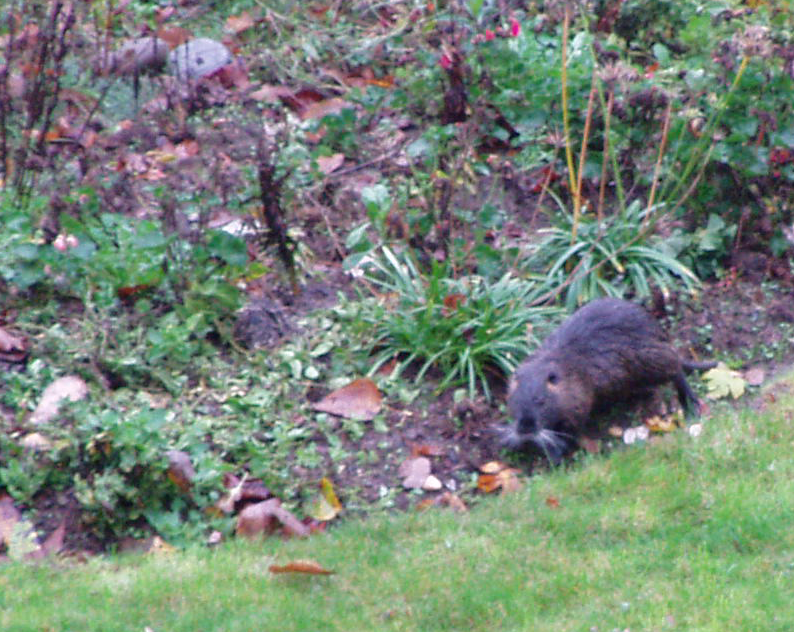
Nutrias are perhaps best described as vegetarian and partway between a beaver, a rat and especially the muskrat, and related to all three. They are aquatic and if lacking predators overuse their habitat by constant grazing. Originally imported into several parts of the USA as a boon to the fur industry, this fur-bearing animal was actually trapped heavily for the fur trade, with up to 1.8 million harvested in a single year in Louisiana alone. Fur fashions change and now demand and prices are so low that the nutria are rarely trapped and have reached pestilential status everywhere. Some states have proposed eradication as a solution to the damaged wetlands they cause. Others see them as an unsolvable nuisance.
Before the old apple tree fell, nutria would travel a long way uphill from the river to feast on the windfall fruit. They would return your gaze with a look apparently both dumbfounded and astounded before lumbering off back to the water. Though efficient swimmers they are slow on solid ground.
Thursday, November 02, 2006
Hummingbirds in the Strawberry Tree
In front of the house, along the circular drive, are three 'dwarf' strawberry shrubs. This one is very unusual in that its fruit take a full year to ripen, so flowering and fruiting overlap in time. Like some plant from the Celtic Otherworlds, the white blossoms expand among the ripening fruit from the previous year. The small blossoms that have begun to attract late-season hummingbirds - daily, at about a quarter after nine.
It is unusual for hummingbirds to visit this type of flower - but hunger is no doubt a factor. Little else is available in early November. We have a few spikes on penstemon and cape fuchsia, and some daisies, but these have suddenly become attractive to them. In spring one does not see them visiting similar flowers, such as andromeda, as more appropriate trumpet-shaped flowers are there for them then.
The strawberry tree is certainly an attractive shrub. Its reminiscent of the manzanita of America’s West, and indeed it is a close relative of it. The compact form which we have is definitely shrubby and 10 to 12 ft. high (3 to 4 m.), while the wild form from the Mediterranean is more treelike and can reach 35 ft. (11 m.) The species ranges from southwestern Ireland to Asia Minor.
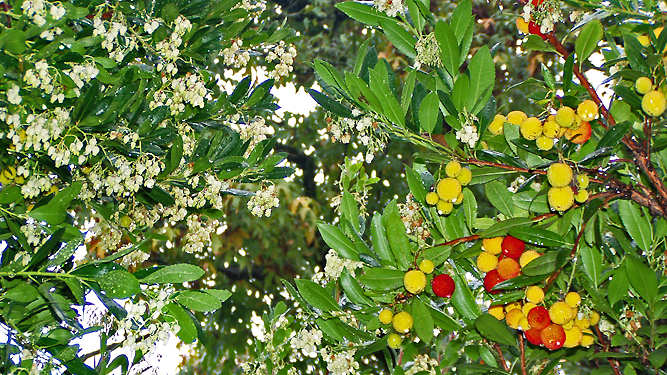
The flowers are shaped like upside-down urns, and are of typical form for the heather family. They are a clear white and are very numerous. They open over a three month Fall period for us, with a few strays towards Spring. The round fruit stays small and green through summer, and not until late in that season do some enlarge and turn yellow and then red. Like the flowers, the fruit mature over a period of months. Both flowering and fruiting can be affected by hard frosts in the northern part of the Strawberry Trees range. In milder zones both can continue into winter.
The plant is evergreen, of medium texture, and grows at a moderate to fast rate. The foliage is a medium green and the bark orange, with the new growth stems sometimes red. It accepts pruning well, and can be handled according to your desired end results. Keep it smaller and shrubby, even hedged, by cutting back strong leaders or even with shearing. If you have room, prune it up and it turns into a nicely gnarled tall shrub. If you open it up in addition, and it can be a airy screen rather than a dense hedge.
This is cold hardy rated from USDA Zones 7 to 9, or down to about zero F. (-18 C). It takes truly hot summers well - tough enough for AHS Heat Zones 3 through 9 (meaning it still thrives with up to 150 days yearly above 86 F. (30C.), or as few as 7. And the drought tolerance is great! Even in the summer-dry American West it does well with little or no water, and in summer wet climates (like the American Eastern Seaboard) it definitely is better without watering.
The botanic name is Arbutus unedo compacta.
Friday, September 01, 2006
Hummingbird Flower
The Hummingbird Flower’ is a welcome addition to our garden. We acquired 5 of them in 1 gallon cans last year, spaced them about 2.5 ft. apart. They filled in well in two months. They’ve blossomed prolifically since just after planting in early July. Heaviest bloom comes in late summer and into Fall. The sprawling growth is thick enough to keep out most weeds, even in its first season. Its drought tolerance is evident too, as our sporadic waterings here in the summer-dry Pacific Northwest has stressed some other new plants but not this one! 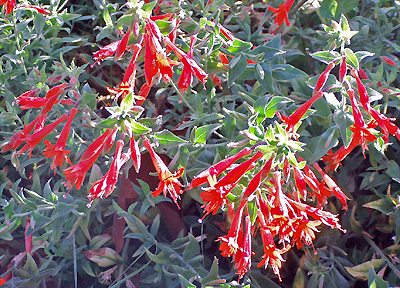

Hummingbirds are commonly said to love this plant, however that is not the case here. I’ve seen them occasionally checking them out, but they much prefer Cape Fuchsia or even Jupiters Beard! Perhaps the cats dissuade them from feeding fron the low flowers.
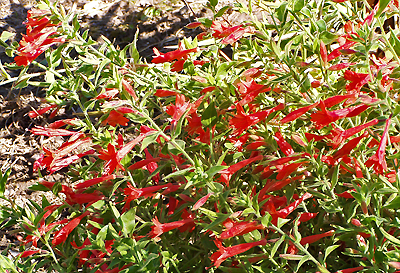
This selected form was originally found by David Salman of High Country Gardens in Santa Fe. It won the 2001 Plant Select award. Its native to the Rockies and other mountains from north Texas to Wyoming. It is hardy to USDA zone 5-9, borderline in Zone 4. Less than a foot high, it can spread over time to several feet across, rooting as it goes. 
We have growing elsewhere the pink form of California Hummingbird flowers,Zauschneria californica “Solidarity Pink”, the California Hummingbird Flower which is perhaps more drought tolerant than garrettii. However, its flowering season starts a little later. Some of it has never been watered this year, especially the largest patch growing in the roadside gravel. Its growth habit is very similar to “Orange Carpet”. The two colors don't mix well in the landscape, but there are plenty of flowers that will. They do make a good groundcover under or in front of medium to tallish perennials like penstemons, lilies or some of the daisies. Blues or purples can mix well with either of these two, and the orange can handle yellows as well. 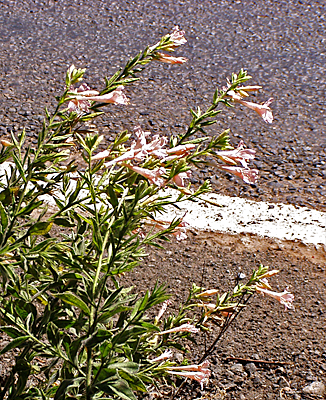
In hotter climates than ours, like the Southern California desert or parts of the Old Southwest, shade is recommended for both species. If you are up North, give it sun, but down South consider at least some shade. In hot dry locations, shade is a must. Some water helps it keep blooming, especially in hot dry gardens.
Botanists have reclassified all Zauchnerias as Epilobiums, or as a type of fireweed. These changes will be slow to make it to gardening circles, as from a landscape standpoint fireweed and hummingbird flowers are distinct. The original Zauschneria garrettii ‘Orange Carpet’ is correctly according to the botanists Epilobium canum spp. garrettii ‘Orange Carpet’, while Z. californica is now E. canum spp. canum. You will see many sources using the form cana, which correctly matches Latin gender for Zauchneria, but to match Epilobium use canum.
John Muir mentions passing large patches of Zauchneria while heading towards Black Mountain Glacier near Yosemite in his 1888 book titled “Picturesque California”. Old references like this are the main reason for remembering superseded botanical names.
Sunday, August 27, 2006
Stargazer Lily
This bright red has about as much impact as any lily out there. The color is far from understated, and the wide blossoms face you, not downward like so many lilies, It fact it was named this because the blooms face the sky. The fragrance is concentrated and wide-ranging. It opens in early August here in Western Oregon; for you the exact time will vary with your climate, as soon as early July in hot Southern areas and late August up North.

Here in our garden it grows a sturdy 5 ft. tall, so its easy to nose up to for the fragrance. Ours are not in the best of soils but are increasing and blooming well. There have been no pest problems at all. Like most lilies, give it sun and good drainage. Some gardeners in the South think its better in shade to preserve the flower color, so the general rule is more sun to the North, and more shade to the South. It needs no staking. Deadhead to get more plant energy into a bigger plant for next year. It grows well in Zones 4 to 9, taking temps down to -25 fF (-32 C).
Be careful to verify you are really getting the true Stargazer - reports indicate some nurserymen may be substituting other less popular lilies for this one.
