Friday March 7th we skied and skijored into Trillium Lake. This former swampland and meadow was turned into a 65 acre lake in 1960 by the Oregon Department of Fish and Wildlife. The first picture is from the road atop the dam. A little known historical fact is that the Oregon Trail (AKA The Barlow Trail in this area) headed North toward Summit Pass on land now under this lake. Logs were placed over the marsh to make the route possible for the pioneer wagons. Some distance North of the lake the Trail route angles left towards Summit Meadows and the Government Camp area. 
Shadows on Trillium Lake
All of the old Barlow Trail in this area offers good cross-country skiing, some of it demanding, some easy. The section nowadays called The Toboggan Run features a moderately steep sharp angled twisting run, some of it still a single head-high rut left by the pioneer wagons of 130 to 170 years ago. Its a great practice run for anyone wishing to learn quick turns-on-demand with cross-country gear. The easier route down to Summit Meadows connects with the access road to the campground and hence onto the Oregon Trail. This leads to easy access to the high route along the West side of the lake, dropping down to the dam.
We took the road route from Trillium Lake Snowpark. This leads to the campground and boat ramp at the southeast edge of the lake. These are hidden in the trees on the right of the trees in the first picture. Despite being widely touted as a beginners area, Trillium Lake features a steep initial run which can be challenging in fast conditions. Today the ten inches of fresh snow over a dense snowpack was slow and easily managed. The loop around the lake is groomed regularly, and in fact was groomed while we were there in preparation for the weekend. 
Trillium Lake Skiers
The grooming is great for skijoring. Let the dogs run to the bottom of that initial hill, and then hook them up. The terrain around the lake is easy to moderate and well within the ability of a trained skijoring dog.
This area with its large parking area sees quite a bit of use. Years ago this was primarily a cross-country area. More recently the slower sport of snow-shoeing has become very common here as elsewhere. Skijoring is the newest variation and is rarely seen. I thought I spotted one on this trip but it turned out to be someone holding their young brittany spaniel on a leash. Most dogs love the snow. Overheating is their great foe and the cold mountain temperatures and snowpack is to their advantage during exercise. Temperatures started out in the low 20’s f. and rose only a little. Trees in bright sun dripped a little but the forest remained snow-covered.
As there is some longer climbing ski routes in the Trillium Basin the area attracts skiers of many abilities. In the second picture two skiers are barely visible seemingly skiing the edge of the cloud-shadow near the North end of the lake. Their shortcut will save a mile or two of road skiing but leads to steep bushwacking on the west side. East of the lake on sideroads you can climb to viewpoints and some moderately challenging downhill return runs. Years ago one such trip lead to a pleasant moonlit ski back. There is nothing better than skiing under clear skies and a full Moon!
This is Tannhauser - trail training name Tanner - cooling off after release from skijoring duties. A chocolate lab - German shorthair mix, he has the stamina and energy to make a great skijoring dog. Husky, Bernese or Swiss Mountain Dog, and general mutt also all can make useful dogs. Avoid dogs with long hair between the pads which will collect balls of snow, such as Golden Retrievers. They otherwise would be great, but snow collecting on the feet makes them a no-go. In Scandinavia where skijoring began a Greyhound-German Shorthair cross is widely used as the ideal combination of traits.
He pulls strongest with other dogs, and needs more training. I’ve only had him a month so this is hardly surprising. The stolen Maya was further along on training but has been gone for over a month. Another dog is in the offing, both for skijoring and a playmate and training partner for Tannhauser.
We were attended to by a small flock of gray jays. These are a restrained white, gray and black combination. I’m more used to seeing the larger, solid gray and more jay-like Clark’s Nutcracker.
After taking photos here, we turned back, and there was a raven inspecting our pack! Tanner made a run at the bird but cut it short as the bird quickly returned to the sky. More interesting were the otter tracks. 
This picture is from the dam and shows the outlet of the lake. The long track is that of an otter. Other partially snowed-over otter tracks are visible nearby. The recent track heads directly to an otter den at the far edge of the lake. 
The Long Trail
Otters are distinctively thick-tailed creatures, and the track clearly show that. The small roundish footprints were mostly rubbed away by the tail dragging behind.
Doubtful or disinterested or tired otters will drag their tails. We had a demonstration of that on our riverfront in 1996 after the massive floods of that year left bare sand everywhere below about the 40 foot elevation mark. That silty sand recorded well the tracks of all animal traffic. Mink, sandpiper, and weasel tracks were spotted.
Though always present in the Clackamas River, this time of bare earth gave us a chance to observe their behavior though tracks the April following the big flood. Two of them came up out of the river from different locations, tails dragging. They sauntered their individual wandering routes towards a large rock which was then located in what is now our labyrinth. The pair headed uphill across an eroded riverbank to the edge of a flat area with foot-high grass. An area of grass larger than a pair of otters was knocked down. Pleased with this roll in the hay, the pair walked back to the river side by side. The pair was enthused enough to hold their tails high the whole way, leaving only their round footprints. 
At Trillium Lake the tracks head one direction, judging from the small sprays of soft snow along the outside edge of the marks. The direction of travel is away from the lake outlet area. The route ends at the otter’s den at the edge of the lake. 
Since the tracks all head one direction, the otter (or otters) must enter the lake at the den, fish their way over to the drain opening, and return back across the snowy ice. The two openings each may access the lake. The narrow track coming in from the right shows they slide in, legs tucked back, leaving no footprints.
The larger opening has approach slides in three directions. The small root highlighted by the snowy background shows the den is underground.
Tanner, nosey dog that he is, wanted to investigate further, but I would not let him. The photos were taken with a telephoto to avoid disturbing the residents.
Want to visit this area? From Portland proceed up Hwy. 26 past Government Camp and look for signs directing you to the Trillium Lake Snowpark on your right. The parking area is large but can be about full on weekends. In Summer you can drive in.
View Larger Map
Sunday, March 15, 2009
Trillium Lake

Wednesday, April 02, 2008
Return of the Osprey
We first heard and then saw osprey March 27th, two days earlier than last year. Their distinctive and frequent high-pitched calls make them impossible to miss.
This species is recovering from low populations earlier in the 1970s and 80s. We did not observe them until 1991. In the subsequent year there were three - the parents and their single offspring who sometimes followed them and sometimes not.
These birds mate for life, and the father does all the hunting while nesting is underway. 
Trees are the favored perches for osprey. They will wait for a likely meal to surface and then dive feet-first into the water very rapidly. Sometimes they hover like a kestrel waiting for the fish to surface. Once a fish is caught, they carry it in the most aerodynamic way possible - face first. Rarely if hungry they will catch small animals but well over 99% of their diet is fish.
Trees are also needed for nesting sites - and only large trees will do. They have been known to use cliffs and various man-made structures for nesting sites. As suitable sites can be rare with the lack of old forests, nesting platforms can be made that they find very useful! Some studies have found that these purpose-built designs actually increase the number of hatchlings, as they are more stable and require less nest building by the birds.
Monday, September 10, 2007
Osprey Bathing
We were surprised to spot an osprey bathing in the Clackamas River just below our house. Taking advantage of the broad shallows, the bird was taking its time. After watching for 5 minutes I attempted to get a photo. The osprey took offence before I was 100 feet away, and flew off.
All our osprey disappeared south during the first week of September, a little earlier than last year. During the Down The River Cleanup on Sept. 9th we observed three osprey upriver from here. So some tarry longer than others.
We had three pair fishing here, up from two last year. One pair always flies upriver to points unknown to me. The others head downriver to nests in cell phone towers. These towers are a major boon to osprey - large snags suitable for nest building are in such short supply that it is the major limiting factor in this population. Big cottonwood or Douglas fir snags are rare nowadays, and snags by definition are short-lived. A mammoth fir snag in Mary S. Young State Park on the Willamette River fell about 10 years ago, and a large cottonwood overhanging the Clackamas 4 or 5 miles upstream from here crashed down 3 years back. So its off to the cell phone towers for the osprey which were using those nest sites. The natural snags may take many decades to replace.
Its possible to build towers for osprey nesting. A telephone pole, some crossbeams, a few planks, at it looks like home to an osprey couple. If even a small handful could be scattered along the river the osprey population would greatly expand.
Thursday, July 12, 2007
Clackamas Headwaters Tour
This excursion is one I set up for The Clackamas River Basin Council, and lead for them the first time this year. In it participants visit a series of springs and lakes all of which are headwaters of one fork or tributary of the far-flung Clackamas River. Date was July 8th.
We visited in order deep bright blue Little Crater Lake, teal-colored Clackamas Lake and nearby Forest Service museum, Summit Lake, Lower Lake, and Head Lake. Finally we barely passed out of the Clackamas watershed to visit Olallie Lake, store and resort.
Though our group saw no single wildflower display to match that in Pansy Basin, there were a variety of sometimes unusual plants present in bloom. The peak of the Cascade Mountain butterfly season was only a week off, and we saw hundreds of them from several species - orange, black, white, blue and yellow colors usually with two or more per kind. A large black and white one was seen once; a pale yellow, orange and black one was very common.

Our route passed through the Summit area on Mount Hood with the intent of entering the Clackamas watershed on its northeast side and ending up in the southeast corner. This allowed us to traverse mid-elevation areas only lightly eroded as well as higher areas with many lakes due to sheet glaciation during the last ice age. Elevations visited range from 3300 to 5000 feet (1000 to 1525 meters), so includes mid-elevation sites up to the watershed boundaries. Much of the route (up Forest Service Road 42 and then 4220) was through dry piney woods with much eastside influence. Firs were always present but the pines dominated much of the area. A beetle infestation has killed thousands of pines in this region. Its a borer whose larvae girdle the tree. This is heavily affecting this region, especially lodgepole pine but also the larger white pine. 
Little Crater Lake is an artesian spring which has carved out a 45 ft (14 m.) deep lake in the soft siltstone. The pure, cold water displays a striking deep yet bright blue. It was named by comparison to the much larger water-filled caldera in Crater Lake National Park. You can see whole trees at the bottom, preserved by the 34 degree (1 degree C) water. Elevation here is the lowest of our stops at 3250 ft (990 m.).
In the wet meadows the white bog orchid was making a show. (Habenaria dilatata). These sturdy perennials are quite obvious and showy spread throughout the acres of damp meadow. Other common names include bog-candle and scent-bottle.
Another perennial flowering in the meadow was a St. Johns Wort (Hypericum formosum scouleri). Though related to the European species which sees use as an herbal anti-depressant, this one sticks to wet meadows, rather than dry ground. Weather it has herbal uses is unknown.

Next we visited Clackamas Lake, which has cold springs both in and just above the lake. This lake is tinted a teal due to Mares Nest algae growing there. Its not fully understood why this lake has so much that it colors the water. Perhaps temperature, perhaps something else or some combination of factors. Elevation here is 3400 ft (1035 m.)
The lake is surrounded by wetlands and meadows which host a number of unusual plants. Betula glandulosa is a small birch which is common in the wetlands. This is very shrubby, growing 5 to 10 feet high (1.5 to 3 m). It is small leafed and not particularly ornamental. The swamp cinquefoil (Potentilla palustris) shares the wetlands around the lake with the birch. Its flowers are a dull dark red-purple, much unlike its usually yellow relatives. Potentilla is a large genus of the rose family, and includes both perennials and shrubs, some useful as ornamentals and offered in the nursery trade.

Just downstream from the lake is a Forest Service museum, housed in a 1930's Civilian Conservation Corps-built guard station. The structure was crafted almost entirely of clear fir, then widely and cheaply available. Twenty-foot long knotfree tongue and groove paneling line the walls. Such lumber can scarcely be found today at any price.
This small museum contains examples of early 20th Century equipment 70 and more years old, along with period photographs. The volunteer staff is talkative and informative. 
We were also treated to a tour of a nearby cabin also part of the 1930's CCC legacy. Its now rented out for only $80 a night ($100 weekends). The two story structure has beds for 9, includes a kitchen and woodstove and a wonderful view at the edge of Clackamas Meadows, with old growth out the back.

Further down the road we visited Summit Lake. A mile off the road down an upgraded gravel road, it features picnic tables but no other facilities. The maps show a creek entering and exiting this lake, but in reality none exists at any time of the year. Springs and underground drainage must exist to keep the water level even. It will drop less than two feet from its depth during our visit by the end of summer. A similar rise would overtop the road, which judging from the complete lack of erosion never happens. This lake is inhabited by very shy ducks who keep to the untracked east shore away from people. Colorful dragonflys abound, and huckleberries fill the forest floor. At 4200 feet, this lake has both low and high elevation trees.
Heading down the 42 Road keep an eye open for 4220 painted in green on the pavement - with frequently disappearing road markers this has proven to be successful in guiding travelers. The junction is easy to miss. The route changes to gravel or dirt, following the old Skyline Road. Along the route Lemiti Creek and wetlands prove to be attractive. Once away from the creek the junction with FS Road 4690 is reached, with a better gravel road ahead for the rest of the trip. 4690 is a good return route to return through Estacada. Pavement is reached soon and then a high speed road most of the way back.
Heading south past the junction Olallie Meadows and Campground is reached on the left after a little more than a mile. The meadow is bisected by the boundary with the Warm Springs Indian Reservation. Nearly 3 miles past this we stopped at Lower Lake Campground to access the trail to Lower Lake. The longest hike we undertook, the stroll to the outlet of Lower Lake is less than a 1.5 mile (2.25 km) round trip. Elevation here is 4740 ft (1445 m.).

Unlike most viewpoints, you hike down to this one. This unimpeded view of Olallie Butte and the length of the lake is the reward for this short jaunt. Olallie is a young volcano with its most recent red-tinted cone obvious and little eroded. The far eastern side shows signs of glaciation, perhaps late in the last ice age. Its height is 7215 feet (2200 m.) and it is only 2 miles (1.25 km) distant.
The stony forest floor offers a scattering of wildflowers and many huckleberry plants of several species. Along the lake we found a butterfly hangout - about 25 in a few square feet. A single osprey flew off towards Olallie Butte and disappeared. 
Only a mile down the road we rolled out of the vehicles to view Head Lake at 4935 feet (1500 m.). The ridge in the background framing Mount Jefferson is the boundary between the Clackamas and Deschutes River drainages. The Pacific Crest Trail follows that ridge. Head Lake's outlet is dry at this time of year, but signs of flow earlier are obvious. It is the head of Squirrel Creek. The mainstem Clackamas originates on the north side of Olallie Butte perhaps a thousand feet (300 m.) below the summit. The steep trail to the top passes close by the source. The Clackamas watershed collects about a third of the Buttes runoff, the rest running to the Deschutes.
Our final stop was Olallie Lake, just over the divide from Head Lake to the southeast. This mile-long lake is the largest in this glaciated region. We parked at the store lot. Cabins are available at the resort as are non-motorized boats. Two pair of Ospreys soared over the lake.
Our return route took us down the mainstem Clackamas River. We quickly left the dryer woodlands for the rainforest dominated by Douglas fir typical of the Western Cascades. Occasional views of the river and patches of old growth are a feature of this route.
Sunday, December 10, 2006
Oaks Bottom Wildlife Preserve Tour
After several visits, here is some commentary on Oaks Bottom, a park and wildlife refuge on the Willamette River in Portland.
Dozens of great blue herons stand in the open, shallow lakes, just far enough apart to be out of beaks reach of each other. The grey color of both the water and the herons made a close look necessary to pick them out. The joggers running by will miss them easily. A single bright white great egret slowly strode across a marshy area, acting no different from the great blues but certainly standing out in the crowd!
A smooth asphalt handicap-accessible path runs North and South from just upstream from here and miles downstream into Portland, ending at the Steel Bridge. The way crosses on a pedestrian path under the bridge and loops through the urban parks of the Portland Waterfront area. This complex of walkways gives Portland a unique combination of urban and nature. It's popular with cyclists, walkers and hikers alike. We brought Grandma in her wheelchair, as nature is one of her few pleasures at 82. Its possible to link this path complex with the more easterly sections of the Springwater rails-to-trails project, bringing several other parks within cycling distance on a day trip. On foot this will take more than one day! The trail section from Oaks Bottom east is funded but yet to be constructed, so a short jaunt on city streets is necessary. To find a route, just drag the Google map to see the streets. The trail crosses 99E on a new bridge near Ochoco Street at about 19th Avenue The trail follows Johnson Creek Blvd for quite a ways, then Foster, eventually ending at Boring. An eventual expansion will follow the old rail line to Estacada, and hence into the Cascade Mountains and the Pacific Crest Trail. So one day it may be possible to start a hike in downtown Portland and end up at the border with Canada or Mexico.
Some unpaved side paths lead to Willamette River views while others circle the lakes and wetlands of the bottoms. More trails link with the Southeast Portland Sellwood neighborhoods. In the pictures here note the skyscrapers of Portland in the background. On the far side against the bluffs wood ducks and the prolific mallards are crowded in their abundance. These ducks seem to prefer being near the small logs blown to this side of the lake. They can use them for perching out of the water yet still be away from shore and its dangers. A single surf scoter was sighted, rare inland from the Pacific and almost never seen in Portland.

Between the marshes and the Willamette River is first a much used railroad track and then the 44 acre (17.8 h.) Oaks Amusement Park. It's been there since 1905. In the 1800's the river connected directly with the bottoms, and the bottoms extended another mile North. The South end became a garbage dump,and the North was largely filled in with debris from freeway construction.
See our earlier Great Blue Heron post
Go to a Google Map of Oaks Bottom Wildlife Preserve. Start at the bottom center of the map, finding the label 'Oaks Pioneer Park'. That park is on top of the riverbank bluff, and Oaks Bottom is below, the brownish area to the north of the label. The Google arial photo was taken during the summer low water.
Sunday, November 19, 2006
Cormorants
The first sighting of double-crested cormorants happened this past Friday, November 17. Most cormorants are seabirds, but this one lives and nests inland as well, here in the West as well as on the lakes of the Plains States east down the Great Lakes and St. Lawrence.
These birds are mostly black, goose sized but slender, and up to nearly a yard (9 dm) tall. Weight is up to 5.5 pounds (2.5 kg).These birds swim low on the water, seeming smaller because of this. From the water's surface they leap and then dive into the water to start chasing their fish prey. Surprisingly their feathers are not waterproof. It may be that this makes them less buoyant and faster underwater. They are often seen holding their wings outstretched apparently to dry them. This habit is unique among our local birds, and is no doubt needed without the waterproofing of most diving birds. Two small crests of feathers on the head lead to the name.
We first noticed them about 8 years ago, when they seemed to be strictly winter visitors. This past season they stayed into late Spring. This is one bird whose numbers are increasing, and is actually expanding its range, especially in the Midwest where introduced fish are providing food absent before. Despite much useful habitat for them, they are migrants here.
They seem wary and I haven't gotten a photo yet. As soon as possible a fresh photo or two will be posted.
In ancient times and up into the 1600's it was thought cormorants were a type of raven. The Ancient Greeks called it the bald raven, and the Romans sea raven. In the Germanic languages similar names were originally attached to these birds. Crested kinds were called shags for the topknot, but with the discovery of more species worldwide the distinction and the naming has not held. Indeed one widespread species, the great cormorant, has no crest in Europe but does in Asia.
Thursday, November 02, 2006
Hummingbirds in the Strawberry Tree
In front of the house, along the circular drive, are three 'dwarf' strawberry shrubs. This one is very unusual in that its fruit take a full year to ripen, so flowering and fruiting overlap in time. Like some plant from the Celtic Otherworlds, the white blossoms expand among the ripening fruit from the previous year. The small blossoms that have begun to attract late-season hummingbirds - daily, at about a quarter after nine.
It is unusual for hummingbirds to visit this type of flower - but hunger is no doubt a factor. Little else is available in early November. We have a few spikes on penstemon and cape fuchsia, and some daisies, but these have suddenly become attractive to them. In spring one does not see them visiting similar flowers, such as andromeda, as more appropriate trumpet-shaped flowers are there for them then.
The strawberry tree is certainly an attractive shrub. Its reminiscent of the manzanita of America’s West, and indeed it is a close relative of it. The compact form which we have is definitely shrubby and 10 to 12 ft. high (3 to 4 m.), while the wild form from the Mediterranean is more treelike and can reach 35 ft. (11 m.) The species ranges from southwestern Ireland to Asia Minor.
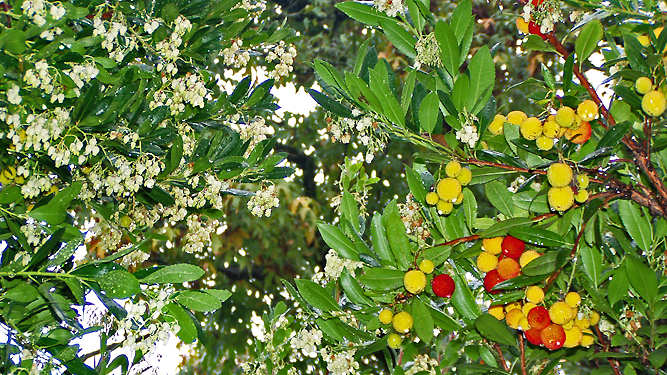
The flowers are shaped like upside-down urns, and are of typical form for the heather family. They are a clear white and are very numerous. They open over a three month Fall period for us, with a few strays towards Spring. The round fruit stays small and green through summer, and not until late in that season do some enlarge and turn yellow and then red. Like the flowers, the fruit mature over a period of months. Both flowering and fruiting can be affected by hard frosts in the northern part of the Strawberry Trees range. In milder zones both can continue into winter.
The plant is evergreen, of medium texture, and grows at a moderate to fast rate. The foliage is a medium green and the bark orange, with the new growth stems sometimes red. It accepts pruning well, and can be handled according to your desired end results. Keep it smaller and shrubby, even hedged, by cutting back strong leaders or even with shearing. If you have room, prune it up and it turns into a nicely gnarled tall shrub. If you open it up in addition, and it can be a airy screen rather than a dense hedge.
This is cold hardy rated from USDA Zones 7 to 9, or down to about zero F. (-18 C). It takes truly hot summers well - tough enough for AHS Heat Zones 3 through 9 (meaning it still thrives with up to 150 days yearly above 86 F. (30C.), or as few as 7. And the drought tolerance is great! Even in the summer-dry American West it does well with little or no water, and in summer wet climates (like the American Eastern Seaboard) it definitely is better without watering.
The botanic name is Arbutus unedo compacta.
Saturday, October 07, 2006
Great Blue Herons
These large predators are frequent visitors here, but the fishermen and others along the river keep them from becoming resident long term. Their harsh guttural squawks can be heard at any time of the night or day. Always solitary in daily life, they surprise everyone by nesting in large clusters of huge nests, from 8 to 170 in a single tree or group of adjacent trees near water.
Last spring we observed a pair flying together or following one another several times, which is unusual. 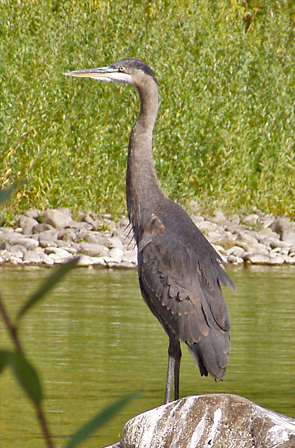
These herons are 'great' due to their size - a wingspan up to 6 feet (1.8 meters) and a height of 42 inches (1.4 meters). Three-quarters of their diet is fish, and are indeed usually seen fishing in rivers and lakes. Great Blue Herons also grab crawdads, insects and frogs. They will hunt in fields for rodents and reptiles. They round out their diet with a small amount of plant materials.
They also adore koi and goldfish in home decorative pools; protective netting may be required if a pond attracts Great Blues. I witnessed one who took up residence near a wealthy man's lakeside estate, where several very fancy koi were kept in a very expensive Japanese-style pond complex. Both he and his butler were fascinated with the huge bird landing in the big firs around the neighborhood. Then some $250 koi went missing, and it wasn't until the pond maintenance workers put two and two together that the mystery of the missing fish was solved.
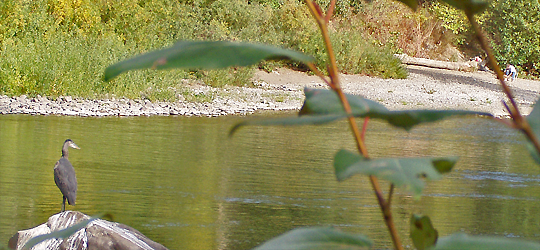
Great Blue Heron range widely - across the continent, into the high Cascade Mountain lakes, down to the Gulf Coast, Mexico and well into Canada and southern Alaska.
Thursday, September 14, 2006
The Big Drawdown
Observing feeding rates at your bird-feeders will give you some good information about your ‘clients’ or ‘customers’ - your backyard birds. We have two thistle feeders for the bright goldfinches and two more with a sunflower/cracked corn/millet/etc. mix that provides for red-headed house-finches, wrens, towhees, parasitic cowbirds, chickadees and others.

Of course feeding is strong and continuous all during the nesting process. Food must be brought to the nest sitter and so the more vivid males are seen more frequently than their mates. This all becomes ‘normal’ spring into summer.
The first ‘Big Drawdown’ comes when the young fledge and are brought to the feeders by the parents. After a visual diet of bright yellow male birds, the light gray young remind you of going back to a black and white TV after your color set goes out. The young have the same color patterning as the adults, just in blacks and grays. The young male goldfinches have the same black facial mask, and otherwise they would be hard to distinguish from other species of young birds! The rapidly-growing broods come knowing how to eat, and the seed levels drop quickly.
The second ‘Big Drawdown’ isn’t from the increasing population of birds, but from a more hidden force. The same young and their parents come, but the seed levels in the feeders again drop at an accelerated rate. Instinct tells young and old alike to prepare for the big migration South. I’ve never seen a truly overweight wild bird, but its certainly not from a lack of trying! This spurt of feeding came about the 20th of August this year, and continues a month later.
Sunday, September 03, 2006
Osprey
We are still hearing the high pitched calls of Osprey, and see them landing on their favorite perches both sides of the river. Osprey live exclusively by fishing. They watch and wait on riverside perches quite a bit and also hover over the water just in case a fish resurfaces. The dives are spectacular and swift - they wouldn't catch many fish otherwise. They hit the water talons first and can go completely underwater. A young one this season was a hesitant diver - and it showed in his results. We estimate that most osprey are successful about one out of three dives. This youngster would stop at the beginning of his dive before finally heading down, by which time the fish, unaware of the osprey, would dive and escape the subsequent impact of the young osprey.

Our section of river is being shared by two pair of osprey this year. One pair nests in a cell phone tower a few miles West next to The Nature Conservancy’s Camassia Natural Area, while the others fly off upstream to points unknown. Male osprey do all the fishing during incubation and brooding. We can observe the birds much of each day during this period. Once the young are fledged, the adults seem to vary their hunting locations more, and are no longer present daily on our waterfront. The chicks are mature in 7 to 8 weeks, increasing over 30 times in size from hatching.
A major limiting factor for osprey is the availability of nesting sites. If all the good sites are already in use, then younger osprey may have to wait years to begin breeding. Why not erect a artificial ‘tree’ with a platform to encourage nesting? We have been asking ourselves this question for years! This has been done elsewhere, and its time to look into it seriously.
There are four subspecies of Osprey in the world. The American and Eurasian forms migrate, while the Caribbean and Australian forms stay year round in the mild climates they inhabit. Some Mexican and Florida populations also do not migrate. The wingspan can exceed 5.5 ft. (170 cm). Northern populations are larger than tropical non-migrant ones, and the females are much larger than the males. The smallest females are the size of the largest males. The biggest birds weigh in at 4.4 pounds (2 kilograms).
Thursday, August 24, 2006
Canada Geese
We sighted the first large Fall flock of Canada Geese this morning. About 20 silent birds flew low directly over the river, in a ragged lopsided V. This is early for this.
Several pairs raised their young on the Clackamas behind our house. The numbers in each clutch were large but constantly diminishing. These birds mate for life. The growth rate of the little ones is astonishing - they reach near adult size in as little as 40 days.
They flock and float together most of the year in large groups, but at nesting time the pairs find isolated nesting sites away from other geese. This is just the opposite of the habits of the Great Blue Heron.
On of the most interesting places to observe these sizable birds is at Chatauqua Park in Boulder, Colorado. A large number of Canada Geese rest overnight on the sloping mown grass park site. They are quite used to people and you can get fairly close to them. Early in the morning they fly to open water elsewhere. The birds take off one or a few at a time and just be careful to duck!
